

 Admin
Admin
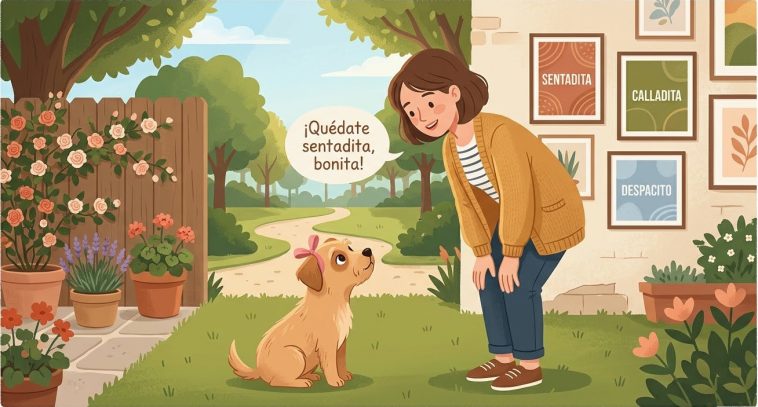
Calladito, despacito: how Spanish uses little words to soften commands
In English, you are just sitting or quiet. In Spanish, you can be sentado, but also sentadito, callado, or calladito, depending on the tone.
Those little endings -ito, -ita, -cito, -cita don’t change the basic meaning, but they change how it feels: more affectionate, softer, sometimes playful or even a bit spicy.
In this post we’ll look at how Spanish uses diminutives with:
– commands with estar(se) like ¡estate sentadito!
– descriptions of behavior like tranquilito or calladito
– adverbs like the famous despacito.
1. “Estate sentadito”: the command form of estarse
When adults talk to children (or pets), they often use a command with estarse plus a diminutive:
– Estate sentadito. (Sit and stay sitting nicely.)
– Estate calladito. (Be nice and quiet.)
– Quédate quietecito. (Stay very still.)
– Ya está dormidito. (He’s fast asleep.)
Grammar tip:
– the infinitive is estarse
– the tú command is estate (and negative: no te estés…)
So “Estate sentadito” literally means “be sitting and stay that way,” but with a soft, affectionate tone.
2. Little endings for posture, behavior and situations
Instead of talking about “states” (too technical), think of these words as talking about:
– Posture: sentado → sentadito, parado → paradito
– Behavior: callado → calladito, tranquilo → tranquilito
– Other situations: dormido → dormidito, abrigado → abrigadito, limpio → limpiecita
The basic idea stays the same, but the diminutive makes it sound softer or more caring:
– Está sentado. = He is sitting. (neutral)
– Está sentadito. = He is sitting nicely / sitting there like a good boy. (affectionate)
Spanish speakers are very creative with this pattern, so your ear will start catching dozens of variations once you know what to listen for.
3. Examples: sentadito, calladito, quietecito, tranquilito…
Here are some of the most common “estado + diminutivo” forms you’ll hear:
– sentadito / sentadita (from sentado) = sitting nicely
– paradito / paradita (from parado) = standing right there
– calladito / calladita (from callado) = very quiet, behaving
– quietecito / quietecita (from quieto) = perfectly still. maybe for a photo.
– tranquilito / tranquilita (from tranquilo) = nice and calm
– dormidito / dormidita (from dormido) = fast asleep (said tenderly)
– abrigadito / abrigadita (from abrigado) = well wrapped up, nice and warm
– limpiecita / limpiecito (from limpio) = nice and clean
All of them can be used with adults too, but with children and pets they are everywhere, because they let you give orders and corrections in a way that sounds less harsh and more caring.
4. Despacio vs. despacito (and other adverbs)
The same trick works with some adverbs. A classic example that is very important to soften commands for instructions, directions, etc.:
– despacio = slowly (neutral)
– despacito = slowly, but with a softer, more intimate tone
In everyday conversation:
– Habla despacio, por favor. = Speak slowly, please. (neutral)
– Habla despacito, por favor. = Speak a little more slowly, please. (friendlier, gentler)
In the song “Despacito”, the word still means “slowly”, but the diminutive adds a sensual, playful nuance: go slow, gently, enjoying each moment.
Other adverbs with this diminutive flavor:
– cerquita (from cerca) = very close, nice and close
– poquito (from poco) = a little bit
– prontito (from pronto) = very soon, really soon
Again, the basic meaning stays the same; the diminutive changes the emotional color.
5. Try it yourself (mini exercise)
Take these neutral sentences and rewrite them with a diminutive. How does the tone change?
– Quédate cerca de mí. → Quédate cerquita de mí.
– Camina despacio. → Camina despacito.
– Está muy tranquilo. → Está muy tranquilito.
– Está sentado en la silla. → Está sentadito en la silla.
Ask yourself: does it sound more affectionate, more polite, more playful… or all of the above?
Want to practice sounding natural in Spanish?
Use sentadito, calladito, despacito like a native, just like real Spanish speakers do.