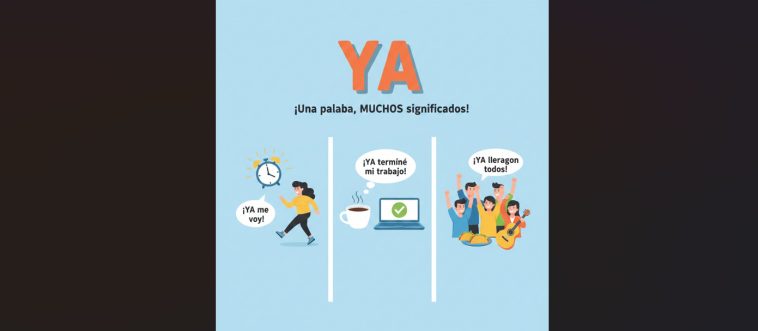
🌀 “Ya” in Spanish: One Tiny Word, Many Meanings
Already, yet, now, not anymore, “I get it”… all in two letters
The little word ya appears everywhere in Spanish, but it doesn’t always mean the same thing. Depending on the verb tense, the tone and the context, it can mean already, yet, now, not anymore, or even “okay, I get it” in a short answer.
You can think of ya as a tiny “time + attitude marker”: it tells you something about when something happens (already / now / not anymore) and also about how the speaker feels (impatient, relieved, ironic, understanding).
Key idea: very often, ya marks a change of state — something was not true a short time ago, and now it is… or it used to be true, and now it is not.
Main uses of “ya”
Here is a summary of common meanings of ya, with short explanations and examples you can use in class.
| 💬 Use of “ya” |
🧠 Basic idea |
✅ Example |
already / yet
Ya with past / perfect tenses |
Something is complete. In questions, it often works as “yet”. |
Ya comí. → I already ate.
¿Ya llegaste? → Have you arrived yet? |
now / right now
Ya in the present |
Now, right away, often with a bit of urgency or pressure. |
¡Ya voy! → I’m coming right now.
Hazlo ya. → Do it now / right away. |
not anymore
Ya no |
A previous situation has changed and is no longer true. |
Ya no trabajo allí. → I no longer work there.
Ya no vivo con mis padres. → I don’t live with my parents anymore. |
eventually
Ya with future |
“It will happen” — be patient, or “just wait and see”. |
Ya verás. → You’ll see.
Ya llegará el momento. → The time will come. |
“I see / I get it”
Short answer in dialogue |
Reaction of understanding, realization or agreement. |
—Es que no pude ir.
—Ah, ya. → Oh, I see / Got it.
Ya entiendo. → Now I understand. |
frustration / exasperation
“Enough already!” |
Impatience, drawing a line, saying “That’s it.” |
¡Ya basta! → That’s enough!
¡Ya estuvo bien! → That’s it, we’re done.
¡Ya estate quieto! → Be quiet now!
¡Ya vete! → Leave now!
¡Ya cállate! → Shut up now! |
everyday chunks
Expressions with ya |
Very common phrases you can learn as complete units. |
Ya ves. → See? / There you go.
Ya me dirás. → You’ll tell me (I’m curious).
Ya te digo. → I’m telling you / Exactly.
Ya para qué. → What’s the point now. (Bad timing.)
Ya pasó. → It’s over now, don’t worry. (Like an earthquake). |
change of state
“Now it’s true” |
Something was not true shortly before… and now it is. |
Ya tengo trabajo. → I have a job now (before, I didn’t).
Ya sé qué hacer. → Now I know what to do.
Ya empezó la película. → The movie has started. |
formal / literary
“Ya… que…” pattern. “ya que”. |
Correlative pair, similar to “sometimes… sometimes…”. “Ya que” means since. |
Ya sea con alegría, que con tristeza.
→ Sometimes with joy, sometimes with sadness. Ya que está lloviendo, hay que quedarnos en la casa.
→ Since it is raining, let’s stay home. |
“ya, ya…”
Skeptical / impatient “yeah, yeah”. |
Short, often impatient or ironic agreement. |
Ya, ya, tranquilo. → Okay, okay, relax.
Ya, ya… (with a skeptical tone) → Yeah, sure… |
“Ya” in other languages
It helps students to see that this idea exists in other Romance languages too. They also use short little words to mean “already / now / right”.
| 🌍 Language |
🔤 Word |
🧠 Rough equivalent of Spanish “ya” |
| Italian |
già |
Hai già mangiato? → Have you already eaten?
Very similar to “ya” = already / yet. |
| French |
déjà |
J’ai déjà fini. → I’ve already finished.
Also appears in déjà vu (“already seen”). |
| Portuguese |
já |
Já comeste? → Have you already eaten? / Have you eaten yet?
Eu volto já. → I’ll be right back. |
| Romanian |
deja |
Am terminat deja. → I’ve already finished. |
Now what?
You don’t need to learn all the meanings of ya in one lesson. A practical first step is to focus on three core ideas: already (ya comí), not anymore (ya no trabajo allí) and now / right now (¡ya voy!). Once those are solid, you can add the more emotional uses like frustration (¡ya basta!), short reactions (ah, ya) and everyday chunks (ya ves, ya me dirás).
The more you hear and notice these uses in real conversations, series and podcasts, the less mysterious ya will feel — and the more natural their Spanish will sound.


 Admin
Admin