

 Admin
Admin
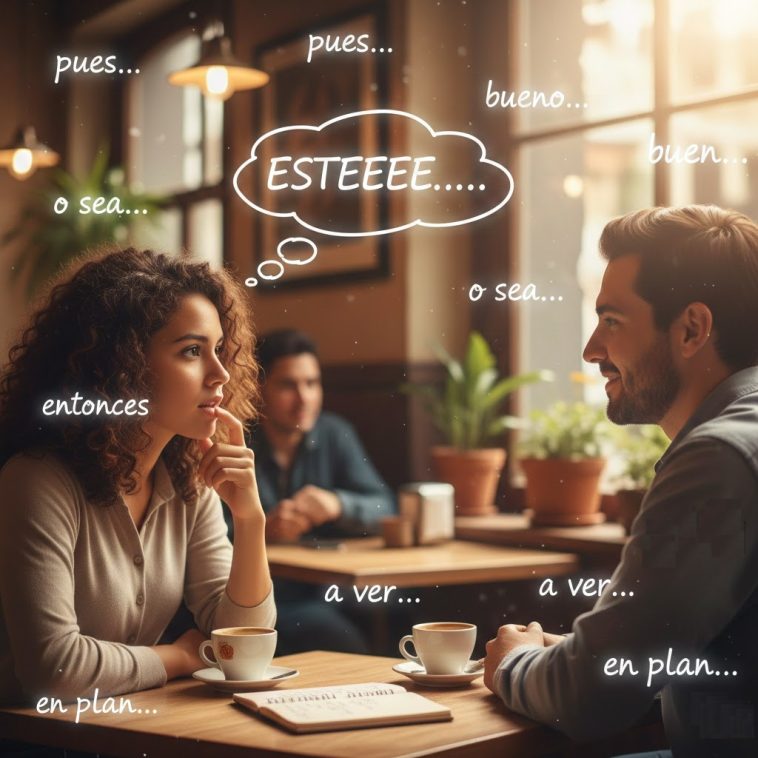
“Esteee…” – The Spanish Word When You Don’t Know What to Say
One of many little Spanish words people use when they are thinking, hesitating… or buying time.
In English we say “uh,” “um,” “like…” when we need time to think.
In Spanish we often say este… — and if we need more time, we make it longer: esteeeee….
There are many other words like this, but in this post we start with “esteee…”.
What does “este…” mean as a filler?
Normally, este means “this.” But as a little filler word, it does not really have a meaning. It is just a sound that helps you keep talking while your brain is working.
It is very similar to “uh” and “um” in English. People use it at the beginning of a sentence, in the middle of a story, or before an answer when they are not sure what to say.
Some “este…” moments
— Este… no sé.
“Um… I don’t know.”
— Pues, esteee… estaba pensando en otra opción.
“Well, ummm… I was thinking about another option.”
— Y luego… este… llegamos tarde a la fiesta.
“And then… uh… we arrived late to the party.”
esteeee… usually means the person is thinking, hesitating, or carefully preparing the answer. Sometimes they are even trying to invent a small “white lie” very fast.Not only “esteee…” – many more little words
“Esteee…” is only one of many small words that Spanish speakers use to sound natural. These words are called muletillas in Spanish. They help you think, start a sentence, change topic, or soften what you want to say.
Some very common filler words
pues…– “well…” (to start a response, or buy a second to think)bueno…– “well / okay…” (to open or close a topic, or agree but not 100%)o sea…– “I mean…” (to explain or say something in a different way)entonces…– “so…” (to continue a story or show the result of something)a ver…– “let’s see…” (when you think, check something, or react calmly)en plan…– “like…” (Spain, not used in Mexico.)viste (vihhhte)…– “did you see…” (Argentina.)
You don’t need to use all of them. You can choose one or two and start playing with them slowly.
So “esteee…” is part of a big family of little words. They are not very important for grammar, but they are very important for sounding like a real person, not a robot.
Where do people use “esteee…”?
You can hear este… in many Spanish‑speaking countries, especially in Latin America. People use it in daily conversations, in stories, and also when they speak in front of other people.
Mexico
Argentina
Uruguay
Chile
Colombia
Central America
Caribbean Spanish
Spain (with “esto…” too)
In Spain, some people also say esto… in a similar way, and younger people use other fillers like en plan. The idea is the same: they need time to think and they don’t want silence.
When “este” sounds like “ete” or “ehteeee”
In some Spanish accents, people do not pronounce the S very clearly in fast, informal speech. This can happen in parts of Argentina, in the Caribbean (for example some Dominicans and Puerto Ricans), and in other coastal or warm regions.
Because of that, este can sometimes sound more like ehhhhte (an aspirated h), especially when people stretch it as a hesitation word.
How it can sound
— Ehhhte… no sé si voy.
“Um… I’m not sure if I’m going.”
— Ehteeee… nos vemos como a las 5.
“Uuuuum… I’ll see you around 5.”
This does not mean everybody in those places speaks like that all the time. It depends a lot on the person, the city, and how informal the situation is. But for learners, it is good to know that sometimes este can sound a little closer to ete in real life.
Mini dialogue: listen for “esteee…” and friends
A: Oye, ¿qué vas a hacer este fin de semana?
A: Hey, what are you going to do this weekend?
B: Mmm… esteee… pues, no sé. A lo mejor me quedo en casa.
B: Hmm… ummm… well, I don’t know. Maybe I’ll stay home.
A: ¿No quieres salir?
A: You don’t want to go out?
B: Bueno… o sea, tengo que estudiar, entonces no sé.
B: Well… I mean, I have to study, so I’m not sure.
How to practice these words
If you are a beginner, don’t worry about all the filler words at the same time. You can start with only one or two: for example este… and pues….
If you are intermediate or advanced, you can add more: bueno, o sea, entonces, en plan, etc.
A simple exercise: record yourself answering one easy question in Spanish. First answer with “perfect” textbook Spanish. Then answer again and add one or two filler words. You will hear the difference: the second version sounds more like a real person.