

 Admin
Admin
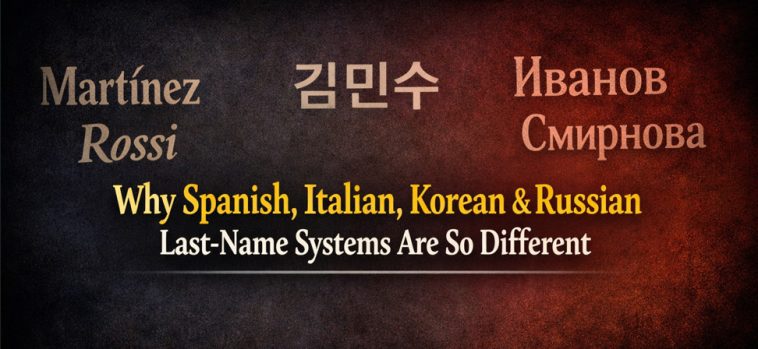
Why Spanish, Italian, Korean and Russian Last Names Look So Different
We usually think a “last name” is something simple: one family name, one family. But if you compare Spanish, Italian, Korean and Russian names, you see very different systems and very different numbers.
how do we name people so we can tell them apart and know where they come from?
Spanish world: many people, shared surnames
In Spanish-speaking countries, millions of people repeat the same classic surnames: García, Rodríguez, González, López, Fernández, Martínez, Sánchez, Pérez, Gómez. These names appear again and again in Spain and across Latin America.
Spanish-speaking countries also use a special system: most people have two surnames (one from the father and one from the mother), for example José Luis Fernández Martínez. This already gives more information about the family line.
200,000-300,000 different Spanish-type surnames.
This means a huge number of people, but a limited “menu” of surnames. The two-surname system helps to distinguish between all those Garcías and González that repeat everywhere.
Italy: fewer people, many more different surnames
Italy followed a different path. Italians normally have one surname, but there is an amazing variety of family names. Of course everybody knows Rossi, Russo, Ferrari, Esposito, Bianchi, Romano, Colombo, Ricci, Greco, Conti. However, beyond those famous ones, there are thousands and thousands of less common surnames, often very local and colorful.
Some examples are Barbarossa (“red beard”), Gambacorta (“short leg”), Bellocchi (“beautiful eyes”), Spagnuolo (“Spanish”, maybe an ancestor from Spain), and many others such as Palumbo, Coppola, Vitale, Serra, Ferraro and Ferretti. Some of these surnames can belong to just one village, or even one extended family.
about 300,000–350,000 different Italian surnames.
So Italy has a similar number (or even more) different surnames than the whole Hispanic world, but for a much smaller population. In other words, Italy has many more different family names in their menu per million people. This is another reason why Argentinians and Uruguayans with Italian last names often use only one and not two last names like most other Spanish-speaking countries.
Korea: very few surnames, many Kims
Korea is almost the opposite of Italy. There are very few surnames in use today, only around 280–300 Korean surnames in total. A very large part of the population shares just three of them: Kim, Lee (Yi) and Park (Pak).
This means tens of millions of people with exactly the same surname. To tell people apart, Korea depends a lot on the full name (surname + given name), on the traditional family clan, and of course on modern ID documents.
Russia: the patronymic in the middle
Russian names use another system again. A typical Russian full name has three parts:
For example: Fyodor Mikhailovich Dostoevsky. Here Fyodor is the given name, Mikhailovich is the patronymic (it means “son of Mikhail”), and Dostoevsky is the surname.
The patronymic is formed from the father’s first name plus an ending. For men it is usually -ovich or -evich (for example, Ivan → Ivanovich). For women it is -ovna or -evna (Ivan → Ivanovna). Many Russian surnames end in -ov, -ev or -in (Ivanov, Petrov, Pushkin), and often the female form adds an -a: Ivanov → Ivanova, Pushkin → Pushkina.
So in Russia, the patronymic and the surname together show the family line very clearly.
Four different answers to the same question
If we put everything together, we see four very different solutions.
In the Spanish-speaking world, there are around 600 million people, a limited pool of extremely common surnames (~200) shared by about 300 million people (50%), so two surnames per person add detail and show both the father’s and the mother’s families.
In Italy, there are 70-80 million people but roughly 300,000–350,000 different surnames, including many very rare and very local names. One surname is usually enough to identify the family.
In Korea, there are tens of millions of people, but only around 280–300 surnames, and huge numbers of Kims, Lees and Parks. The same surnames repeat everywhere, so the full name and the family clan become very important.
In Russia, each person has one surname but also a patronymic built from the father’s name, so the family line is written directly in the full name.
All these cultures are answering the same basic question — how to name people so we can tell them apart and know where they come from — but each one has invented its own, very creative solution.
Sources (for the curious)
Some key places where you can read more (in English):
- Spanish speakers and naming customs:
https://en.wikipedia.org/wiki/Spanish_naming_customs
https://www.bergesinstitutespanish.com/spanish-native-speakers - Spanish surnames and their frequency:
https://en.wikipedia.org/wiki/List_of_common_Spanish_surnames
INE (Spain) – Most frequent names and surnames: https://www.ine.es - Italian surnames and their history:
https://italianismo.com.br/en/sabia-que-existem-mais-de-350-mil-sobrenomes-italianos-diferentes/https://www.ine.es/dyngs/INEbase/en/operacion.htm?c=Estadistica_C&idp=1254735572981
https://olivosantabarbara.com/2018/01/25/a-brief-history-of-italian-surnames/ - Italian population and diaspora:
https://countrymeters.info/en/Italy
https://www.imidaily.com/europe/italian-citizenship-by-descent-up-to-80-million-worldwide-potentially-eligible/ - Korean surnames (Kim, Lee, Park, etc.):
https://www.britannica.com/story/why-are-so-many-koreans-named-kim
https://en.wikipedia.org/wiki/List_of_Korean_surnames - Russian names and patronymics:
https://www.icls.edu/blog/how-do-russian-names-work-a-detailed-guide
https://www.rbth.com/blogs/2014/05/22/ivanov_ivanenko_ivanovich_the_meaning_of_russian_surnames_36851.html