

 Admin
Admin
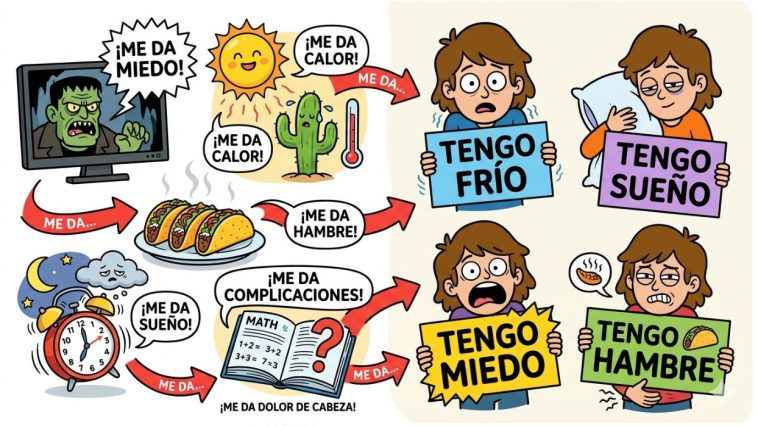
FEELING ALL THE FEELS IN SPANISH: DAR vs TENER
How to say you’re hungry, sleepy, jealous, grossed out and more with fun, natural Spanish expressions.
In English we usually just say “I am hungry / I am cold / I am scared.”
In Spanish, we have two very expressive options to talk about physical sensations and emotions:
- dar + noun: something gives you that feeling. It causes it.
- tener + noun: you have that feeling. It’s your current state.
Same feeling, two different flavors. Let’s see how Spanish speakers play with both!
1. “Dar” feelings: when something gives you the sensation
Think of dar as Spanish for: “This thing makes me feel X.”
A movie can give you fear, a meme can give you laughter, and a plate of tacos can give you hunger.
Structure: me / te / le / nos / os / les + da / dan + noun
Example: Esa película me da miedo. → “That movie scares me / gives me fear.”
2. “Tener” feelings: when you’re living inside the sensation
With tener, you’re not blaming the tacos or the horror movie…
you’re simply saying: “Right now, I have this feeling.”
Structure: tener + (mucho / mucha / muchos / muchas) + noun
Example: Tengo mucha hambre. → “I’m really hungry.”
🔎 Mini grammar tip: these words are all nouns, so we use mucho / mucha (not muy):
Tengo mucha sed ✔️, Tengo muy sed ❌.
Fun fact: some feminine nouns that start with a stressed a use the article el in the singular (like el hambre),
but they stay feminine, so we say mucha hambre.
3. The fun part: a whole menu of feelings
Here’s your “feelings buffet”: same noun, two ways to use it.
On the left, something gives you the feeling. On the right, you simply have it.
The last column shows a natural Spanish idea and its English translation.
| Spanish noun | With “dar” – it gives you the feeling | With “tener” – you have the feeling. Sometimes you can use “sentir”, to feel. | Idea (Spanish + English) |
|---|---|---|---|
| hambre (f.) | Me da hambre. | Tengo mucha hambre. | “Tengo un hambre terrible” – I’m starving. |
| sueño (m.) | Los vuelos largos me dan sueño. | Tengo mucho sueño. | “Me caigo de sueño” – I’m so sleepy I’m falling over. |
| frío (m.) | Esa habitación me da frío. | Tengo mucho frío. | “Estoy muerto de frío” – I’m freezing. |
| sed (f.) | Correr en verano me da sed. | Tengo mucha sed. | “Tengo una sed horrible” – I’m really thirsty. |
| calor (m.) | Este abrigo me da calor. | Tengo mucho calor. | “Me muero de calor” – I’m boiling. |
| miedo (m.) | Tu historia de fantasmas nos dio miedo. (Past tense). | Tenemos mucho miedo. | “Tenemos un miedo terrible” – >We are really scared. |
| vergüenza (f.) | Esa foto antigua me da vergüenza. | Tengo mucha vergüenza. | “Me muero de vergüenza” – I’m dying of embarrassment. |
| ganas (f. pl.) | Con ese video ya me dieron ganas de viajar. | Tengo muchas ganas de viajar. | “Tengo muchas ganas de…” – I really feel like… |
| pena (f.) | Su historia me da pena. | Tengo mucha pena. Siento mucha pena. | “Me da mucha pena” – I feel really sorry for them. |
| asco (m.) | Esa comida me da asco. | Tengo mucho asco. | “Qué asco, me da asco” – That’s disgusting, it grosses me out. |
| lástima (f.) | La situación me da lástima. | Tengo mucha lástima. | “Qué lástima” – What a pity / That’s a shame. |
| rabia (f.) | Esa injusticia te da rabia. | Tengo mucha rabia. | “Me da mucha rabia” – It really makes me angry. |
| orgullo (m.) | Tu progreso nos da orgullo. | Tenemos mucho orgullo de ti. Sentimos mucho orgullo por ti. | “Nos llenas de orgullo” – You fill us with pride. A little different grammar. |
| curiosidad (f.) | Esa historia le da curiosidad a la profesora. | La profesora tiene mucha curiosidad. La profesora siente mucha curiosidad. | “Le da mucha curiosidad” – It makes her really curious. |
| risa (f.) | Ese meme me da risa. | Tengo mucha risa. | “Me da mucha risa” – It really makes me laugh. |
| alegría (f.) | A tus nietos les da alegría verte.. | Tienen mucha alegría. Sienten mucha alegría. | “Les da mucha alegría verte” – Seeing you makes them very happy. |
| suerte (f.) | Ese amuleto me da suerte. | Tengo mucha suerte. | “Tengo mucha suerte” – I’m very lucky. |
| prisa (f.) | Se me hace tarde, ya me dio prisa. (past tense). | Tengo mucha prisa. | “Voy con mucha prisa” – I’m in a big hurry. |
| celos (m. pl.) | Ese comentario le da celos. | Tiene muchos celos. | “Le da muchos celos” – It makes him/her really jealous. |
| dolor (m.) | Esta postura me da dolor de espalda. | Tengo mucho dolor. Siento mucho dolor. | “Tengo mucho dolor” – I’m in a lot of pain. |
4. Quick recap: who is the “subject”?
- With dar, the thing or situation is the subject and you are the indirect object:
Esa serie me da sueño. → The series gives sleep to me. - With tener, you are the subject and the feeling is just something you “have”:
Yo tengo sueño. → I have sleepiness.
Both are correct. Spanish just gives you two lenses for the same emotion:
one blames the outside world, and the other describes your inside world.
Want to practice these expressions in real conversation?
Book a lesson with me at SpanishNY.com.
We’ll use your real life (your hunger, your sleepiness, your curiosity!) to build natural, fluent Spanish you can use right away. This was prepared for Mary’s class. Thank you Mary.