

 Admin
Admin
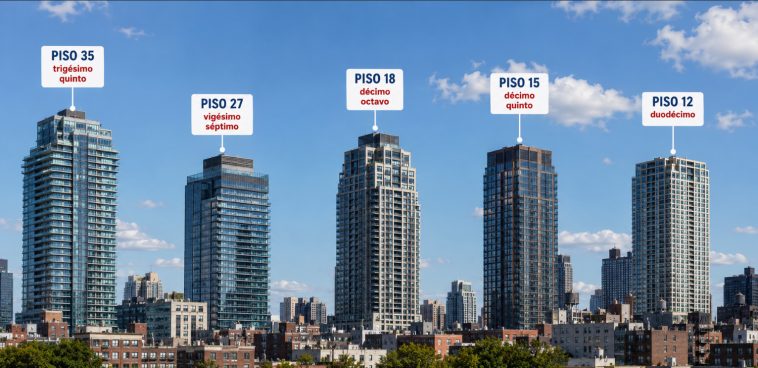
A simple guide to Spanish ordinals, common Mexican usage, and how French, Italian, and English handle the same idea.
Ordinal numbers express order: first, second, third, and so on. In Spanish, the first ten are familiar, but after that the system becomes less regular and more variable in real life.
The standard forms
Traditional Spanish ordinals include primero, segundo, tercero, cuarto, quinto, sexto, séptimo, octavo, noveno, and décimo. They agree in gender and number, for example, Quinta Avenida for Fifth Avenue.
After that, Spanish continues with forms such as undécimo, duodécimo, decimotercero, decimocuarto, and decimoquinto.
For example, 80th, the standard form is octogésimo; for 90th, it is nonagésimo. And so on.
Everyday usage (For example, in Mexico)
In Mexico, people often simplify the system and use forms that come from cardinal numbers. That is why you may hear expressions like onceavo piso (11th floor) or doceavo piso (12th floor) in everyday speech, even though those forms are not the strict standard. Onceavo is partitive 1/11 un onceavo, 1/12 is un doceavo.
These forms are best described as common, informal, or nonstandard. Spanish ordinals can be complicated enough that speakers sometimes prefer the easier option, adding avo, ava, avos, avas especially outside formal writing.
The same tendency can produce forms like ochentavo and noventavo. They are understandable by analogy, but the formal ordinals remain octogésimo and nonagésimo.
Cardinals in titles and names
Spanish also uses cardinal numbers in some names and titles. A well-known example is the pope: Benedicto XVI is commonly said in Spanish as Benedicto dieciséis, not Benedicto décimo sexto.
This shows that written Roman numerals do not always correspond to the ordinal form people would expect. In some fixed expressions, Spanish simply switches to cardinal number to avoid complicated ordinal numbers.
French examples
French is more regular than Spanish in this area. Examples include premier for 1st, deuxième for 2nd, onzième for 11th, douzième for 12th, vingt et unième for 21st, and quatre-vingtième for 80th.
After premier, French ordinals usually follow a predictable pattern with -ième.
Italian examples
Italian is also fairly regular. Examples include primo for 1st, secondo for 2nd, undicesimo for 11th, dodicesimo for 12th, ventunesimo for 21st, and ottantesimo for 80th.
Italian ordinals are still much more predictable than Spanish once you move beyond the first ten.
English examples
English is the simplest of the four in writing because most ordinals just add -th: first, second, third, eleventh, twelfth, twenty-first, and eightieth.
English has a few irregular forms, but the overall system is much easier than Spanish.
Why Spanish feels less regular
Spanish keeps traditional ordinals, but speakers also use simplified forms in daily life. That mix makes the system feel inconsistent, especially after 10.
So while the formal forms matter for writing and careful speech, ordinary usage often leans toward whatever sounds easiest and most natural in context.
Some examples
| Meaning | Spanish (often confusing) | French | Italian | English |
|---|---|---|---|---|
| 1st | primero | premier | primo | first |
| 11th | undécimo / décimo primero / onceavo (informal) | onzième | undicesimo | eleventh |
| 12th | duodécimo / décimo segundo / doceavo (informal) | douzième | dodicesimo | twelfth |
| 16th | decimosexto / dieciséis in the case of Pope Benedict XVI / dieciseisavo (very informal) | seizième | sedicesimo | sixteenth |
| 21st | vigésimo primero. Some people might say veintiunésimo, ventiunavo, which are non standard, and maybe some other improvised variations, or people simply would use the safer cardinal veintiuno. | vingt et unième | ventunesimo | twenty-first |
| 80th | octogésimo / ochentavo (nonstandard). Some people might say octagésimo with “a”, which is not standard.. | quatre-vingtième | ottantesimo | eightieth |
| 90th | nonagésimo / noventavo (nonstandard) | quatre-vingt-dixième | novantesimo | ninetieth |
Now check this madness out
Why Spanish is harder
Spanish preserves old Latin-style ordinal formation much more heavily for formal numbers. For example, 300th is tricentésimo, 500th is quingentésimo, and 900th is noningentésimo.
Then these pieces combine into longer forms. So 973rd becomes 900th + 70th + 3rd, or noningentésimo septuagésimo tercero.
In theory, the system is mathematically systematic. In practice, it is often unusable in daily conversation, because most speakers simply avoid saying such long ordinals aloud.
A funny reality is that many native speakers would probably make mistakes with these forms or skip them entirely and use a simpler expression instead.
Final notes
Spanish ordinals are standard in formal writing (the articles of the Constitution, the Bible, etc.) but everyday speech often simplifies them, especially beyond 10. That is why people may say onceavo piso or doceavo piso, even though the traditional forms are different. In titles and names, Spanish may also prefer cardinals, as in Papa Benedicto dieciséis (Pope Benedict XVI). Compared with Spanish, French and Italian are more regular and simpler, and English is the easiest because it usually just adds -th.
References
- RAE, ordinales and tabla de numerales.
- FundéuRAE, guidance on onceavo, doceavo, and related ordinal usage.
- Vatican News, biographical reference for Benedicto XVI.
- French and Italian ordinal examples consistent with standard grammar references.